Автор: Elena Nezhinsky
•
21 сентября 2026 г.
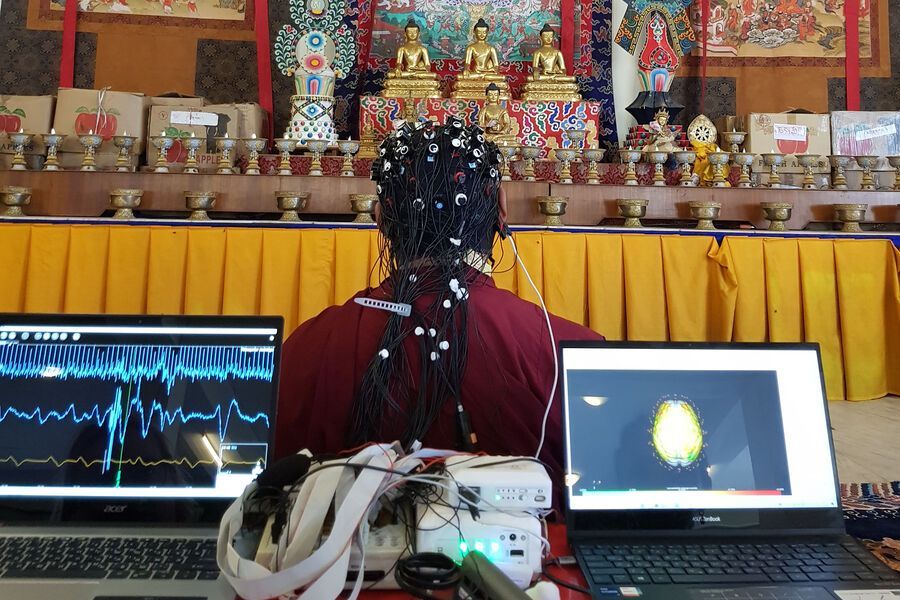
The Mystery of Tantric Meditation Revealed? MSU Researchers Report Findings from Studies of Tibetan Monks Psychophysiologist Alexander Kaplan: “For the first time, we have obtained objective markers of subjective states.” Russian neurophysiologists have announced the first results of a multi-year project studying tantric dissolution meditation in Buddhist monks directly in Tibetan monasteries. The researchers recorded the monks’ brain activity using electroencephalography (EEG). The findings were significant enough to be published in Scientific Reports, part of the Nature portfolio. Alexander Kaplan, Doctor of Biological Sciences, professor and head of the Laboratory of Neurophysiology and Neurocomputer Interfaces at Lomonosov Moscow State University, spoke about what the researchers have discovered over several years of work. How did you become involved in studying meditation in Tibetan monks? In 2018, during a meeting with Russian neurophysiologists at his residence in Dharamsala, His Holiness the Dalai Lama proposed creating a joint scientific project devoted to studying the nature of the human mind through research into the brain mechanisms involved in Buddhist meditation. We began the project that same year. I became especially interested in a particular class of meditation — practices of Highest Yoga Tantra aimed at individual transformation. These extremely complex practices contain a fascinating process. First, the monk mentally visualizes himself in the form of an enlightened deity, and then gradually “dissolves” that image. For practitioners of Tibetan Buddhism, the goal is not simply to withdraw attention from the external world, but to learn to move into deeper layers of the mind, eventually reaching a particular state known in Buddhism as clear light . Buddhists maintain that the “clear-light mind” naturally appears during such transitions as falling asleep, waking up, and dying, among other circumstances. Tibetan monks train themselves to recognize this state and to use it in spiritual practice. Throughout their lives they practice this recognition, believing that spiritual practice performed in this deepest state of mind can lead to profound spiritual realization. The monks most skilled in these meditations became our volunteer research subjects. Is this meditation a single practice, or does it consist of separate stages? According to ancient written sources, the dissolution process in tantric meditation consists of eight stages, the last of which is called “clear light.” Monks in tantric Buddhist monasteries follow the same traditional sequence. For a scientist, this is an extraordinary opportunity: we have a standardized mental procedure being performed by all the participants. All that remains is to place sensors on the monks and observe how brain activity changes as they move progressively deeper into their own minds. And these are people who have practiced for ten, twenty, sometimes forty or fifty years. The difficulty was that tantric monasteries had traditionally been closed to researchers studying brain mechanisms. Recommendations from His Holiness the Dalai Lama, together with the participation of the Russian Nalanda Foundation, opened the doors of tantric monasteries to researchers — although, at present, only to my group. How did you formulate the scientific purpose of the project? No matter how long humanity studies the brain, one of its greatest mysteries remains the same: how does the activity of purely physical nerve cells, electrical impulses, neurotransmitters and other biological mechanisms generate the psychological world of a human being — the subjective reality in which we actually live? From the perspective of practical neurophysiology, we can ask which brain structures, and in what sequence, participate in the activities of the mind. How are mental images created? How is a mental reality constructed from those images? How are emotional states such as love, compassion, joy and grief formed? Which brain structures or networks sustain subjective experience itself? And ultimately, what are the brain mechanisms underlying transformation through tantric practice? The Buddhist monks from monasteries in India, Nepal and Bhutan were not merely our experimental subjects. In a real sense, they became collaborators in this work. Why monks? Wouldn’t artists, architects or writers also be suitable? People in creative professions certainly tend to have strong — sometimes exceptional — capacities for imagination, intuition and visualization. But scientifically they make difficult subjects because every person has a different style, a different skill set and a different developmental history. How do you draw conclusions from such variability? Tantric Buddhist monks, by contrast, have been raised within the same traditions, studying the same texts and training in the same monasteries. For more than six hundred years, generations of Buddhist monks have practiced the same tantric meditation known as Guhyasamaja. During each session, the monks visualize themselves as this Buddhist deity — with three faces and six arms — in extremely precise detail. Then they slowly dissolve that image and other elements of their mental reality. Where else could I find such extraordinary subjects for research into the nature of the mind? Does it really matter that Tibetan monks have trained their imagination for generations? What if you simply asked ordinary people to visualize the same deity? In our university research into the brain mechanisms of imagination, we asked students to imagine closing the fingers of one hand into a fist while we examined which regions of the brain showed changes in electrical activity. This is an extremely simple task, and the expected result has long been known: so-called mu activity should decrease in the motor regions associated with the hand. Yet we observed the expected EEG response in only about 30 percent of the students. Another 30 percent developed the ability after practicing for a week or two. The remainder never demonstrated strong enough motor imagery. And that was only the image of their own hand. The monks are visualizing something vastly more complex. Moreover, they do not simply imagine the form of a deity. At the same time, they attempt to embody within themselves the exceptional positive human qualities associated with that deity. How many monks have you studied over these eight years? At this point we have recorded, analyzed and published results from approximately forty-five monks practicing Highest Yoga Tantra. No other group in the world has a comparable dataset suitable for this kind of systematic research. But collecting it is difficult. Every year we organize two or three expeditions to monasteries in India, Nepal and Bhutan. Even then, a single expedition may yield usable recordings from no more than ten monks. Monks who practice Highest Yoga Tantra are relatively rare within the overall monastic population. They may also be in retreat, where we cannot reach them, or traveling between monasteries. For statistical analysis, we ideally need groups of forty to fifty practitioners for each variation of these meditation practices. We currently have another fifty to sixty recordings being processed and analyzed from monks practicing related meditations within other traditions and procedural frameworks. What about hermits who do not live in monasteries? Have you worked with them? Yes. Hermit monks are often among the most advanced practitioners of tantric meditation. Many live outside monasteries, sometimes high in the mountains in extremely remote locations, so that they can devote their entire lives to practices involving deep exploration of the mind and of their lived experience. We organized a scientific expedition to Ladakh, in the Himalayan foothills of northern India, where hermits have long lived at altitudes of around four thousand meters. It was not easy. We needed recommendations not only from His Holiness the Dalai Lama but also from the teachers directly responsible for these hermits. The hermits were scattered across different locations in Ladakh, so we traveled to visit them carrying backpacks full of research equipment. So far we have obtained approximately ten to fifteen recordings. We have also recorded meditation sessions from hermits living in special retreat centers near the residence of His Holiness the Dalai Lama. In our search for highly experienced practitioners of deep meditation, we also conducted an expedition to the Kingdom of Bhutan, visiting remote monasteries where monks devote nearly all of their time to contemplative practice. How many electrodes do you place on the head when recording EEG? In my university laboratory we can use as many as 256 electrodes. But installing that many electrodes takes a great deal of time. For an experienced monk, waiting for a long experimental setup is undesirable because by the time he arrives for the study he is already mentally preparing for meditation. So in field conditions inside monasteries, we normally use approximately forty-five EEG electrodes. In addition, we use sensors to measure oxygen concentration in the cerebral cortex through functional near-infrared spectroscopy, or fNIRS, across fifty-four locations. With assistants, we can install everything in approximately twenty minutes. Then recording begins, the monk starts his meditation, and we leave the room until he tells us that the practice is complete. The duration varies greatly: from fifteen minutes to an hour and a half. What was your hypothesis? What were you hoping to see in the EEG signals and measurements of oxygenation in the brain? According to the structure of tantric practice, monks pass through eight stages in which mental images are progressively dissolved. In scientific terms, they move through eight successive psychological states, gradually freeing the mind from layers associated with the external physical world — images, thoughts and forms — until reaching what the tradition describes as an entirely pure state of mind: clear light. My hypothesis was that these transformations of subjective experience would have a physical reflection in the signals recorded from the brain. If traces of these stages could be detected in EEG and fNIRS signals, we might then begin to understand which brain structures participate in the subjective movement from more superficial states of mind into deeper ones, ultimately reaching the mysterious state called clear light. In that state, according to hints in Buddhist texts — and, admittedly, some scientific imagination on our part — the integrated experience of a human life may manifest itself. So you were trying to distinguish a meditating brain from a non-meditating brain using EEG? No. Comparing “meditation” and “non-meditation” is largely meaningless if we are talking about a rigorous scientific approach. Meditation is a form of reflection on the nature of one’s own subjective world. Certainly we can distinguish EEG patterns associated with active thinking from those associated with relaxed wakefulness. But EEG cannot simply tell us whether a person is thinking about advanced mathematics, a summer vacation or the nature of their own mind. And these EEG characteristics vary greatly from person to person regardless of whether someone is experienced in meditation or in writing poetry. Our task was different. We wanted to observe how brain activity changed while a tantric practitioner moved from ordinary perception of the physical world toward the state known as clear light. We hoped that, over the course of the meditation, the EEG recordings might reveal several different types of segments that could approximately correspond in number and duration to the stages of dissolution described in tantric practice. Two scientific papers have now been published, with the most recent appearing in Scientific Reports. What were you able to demonstrate? First, our central hypothesis was supported. In the EEG of a monk engaged in dissolution meditation, we were able to identify a relatively small number of distinct segments — usually between six and ten — occurring sequentially and clearly distinguishable by quantitative EEG characteristics. Because similar segments appeared in almost all of the several dozen monks studied during meditation, we cautiously proposed that these EEG segments may reflect stages of tantric meditation. The next question was whether a segment identified in one monk resembled segments identified in other monks. Across the study we analyzed 341 quantitative EEG features. You mean characteristics of brain waves? Have you abandoned the traditional beta, theta, delta and alpha rhythms? Not at all. We simply analyzed the frequency structure of EEG in much greater detail, at intervals of 0.5 Hz. We also included many additional quantitative characteristics: correlations between pairs of EEG channels across different frequency ranges, phase shifts between EEG signals in different channels, and other measures. This detailed quantitative analysis allowed us to identify the segments we were looking for. Each segment was defined by a distinctive combination of characteristics, including frequency-related ones. And were these different EEG segments similar across different monks? Yes. That was the crucial question. Across all of the monks we identified more than four hundred segments. It was entirely possible that each monk would have his own unique pattern of segments. If that had been the case, it would have been difficult to reconcile with the fact that all of them were performing the same structured meditation. But we were fortunate. This became our second major finding: every one of those several hundred segments could be assigned to only eight basic types . That strengthened our hypothesis that these recurring EEG patterns may reflect the same stages experienced by practitioners during tantric meditation — stages leading toward the clear-light state. Did these EEG segment types appear in the same sequence in all monks? In principle, they could have appeared in completely different sequences. Imagine labeling the segment types A, B, C, D and so on. One monk might show the sequence BDACFEHG, another EGAFCBHD. There are more than forty thousand possible combinations. With thirty-five monks, it would have been entirely possible for every monk to display a unique sequence. Had that happened, it would have cast doubt on the idea that these sequences correspond to the eight traditional stages of meditation. But this is where we encountered our most important result. Instead of tens of thousands of possible combinations, we found only six typical combinations of EEG segments. This suggests that monks may perform this particular practice somewhat differently, combining or moving through stages in several characteristic sequences. We identified six groups of monks. Were those groups different from one another in any meaningful way? Very much so. Two of the groups were composed, by about 80 percent, of monks with the greatest meditation experience — those with the largest number of retreats and the longest histories of practice. At the same time, two other groups contained no monks with extensive practical experience at all. This led us to the conclusion that we had identified EEG characteristics that reflect not only the process of meditative dissolution itself but also differences associated with the practitioner’s level of experience. Has this been done for the first time? Yes. These findings offer the first objective glimpse into the processes occurring during tantric dissolution meditation. And because my group is currently the only research team working inside these tantric monasteries, we also possess the largest EEG database in the world devoted specifically to tantric meditation. We are willing to share it. What do these results tell us more broadly? They suggest that unusual states of mind — including the sequential states occurring during tantric dissolution meditation — have measurable correlates in the physiological activity of the brain. Deep meditation can therefore have real psychophysiological consequences and may alter the functional organization or “settings” of brain systems. This may help explain some of the positive psychological changes observed in long-term tantric practitioners. Our next step will be to determine specifically which brain structures and which EEG characteristics are involved in particular stages of tantric meditation. Perhaps this work will bring us somewhat closer to a broader theory of the brain, a deeper understanding of human nature, and eventually to understanding how useful meditative techniques might be applied by ordinary people. Author: Anna Urmantseva Photographs from the personal archive of Alexander Kaplan